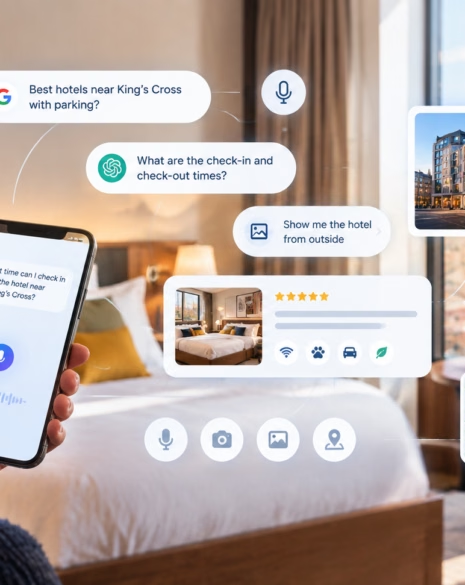
The way travellers find hotels is changing fast.
In fact, search behaviour has changed more in the last 18 months than in the previous 18 years. For hotels, that creates both a challenge and an opportunity. The old rules of visibility are no longer enough. It is no longer just about ranking on page one of Google or having a beautifully designed website. Increasingly, it is about how AI platforms understand, describe and recommend your hotel before a guest ever clicks through.
This shift matters because AI search is becoming a major part of how people discover and compare places to stay. Tools like ChatGPT, Google’s AI Overviews and other AI-powered search experiences are changing the journey from search to booking. And for hotels, that means one thing: your digital strategy needs to evolve.
Search Is No Longer What It Used to Be
There was a time when hotel search felt relatively straightforward.
A traveller typed in something like “hotels in York” or “luxury hotel in Amsterdam”, and the goal was simple: show up on page one. If you invested in SEO or paid search, you could increase your visibility, drive more clicks and, in turn, generate more bookings.
That world is fading.
Search is now far more complex. Google results are increasingly personalised. Different users see different things based on context, behaviour and search history. On top of that, Google is pushing users towards more specific, conversational searches while AI-generated answers are taking up more space in results pages.
At the same time, users are turning to AI platforms because they often produce clearer, more relevant answers. Instead of working through a crowded results page full of ads, maps, organic listings and “people also ask” boxes, a traveller can ask a direct question and receive a short, tailored shortlist.
That is a major change for hotels competing for visibility.
The Rise of Zero-Click Search
One of the biggest shifts in digital visibility is the rise of zero-click behaviour.
When Google shows an AI Overview, fewer people click through to websites. More and more searches now end without the user leaving Google at all. Either they get enough information directly in the results, or they continue exploring within Google’s own ecosystem.
For hotels, that means traffic is harder to earn than it used to be.
This is one reason AI search is gaining momentum so quickly. Traditional search can be cluttered and overwhelming. AI search tools, by contrast, often reduce the noise and present a much smaller number of recommendations. If Google presents a traveller with 20 or 30 possible options, AI may only present three or four.
And if your hotel is not one of them, you may never make the shortlist.
AI Search Is Growing Quickly
AI search is not a fringe behaviour anymore. It is moving into the mainstream.
As usage of platforms like ChatGPT has grown, so too has their influence over how people research products, services and travel. In the hotel space, this matters because AI is becoming more than a research assistant. It is becoming a decision-making layer between the search and the click.
Industry forecasts suggest that AI search could overtake traditional search for many commercial journeys within the next couple of years. Whether that exact timeline proves right or not, the direction of travel is clear: this is happening, and it is happening quickly.
Hotels that wait for certainty will almost certainly be too late.
The Hotel Website Still Matters — But Its Role Is Changing
For years, the hotel website has been the centre of digital marketing.
Its job was to inform, persuade and convert. A potential guest might discover the hotel in Google, click through with limited context, and then use the website to move from awareness to interest, from consideration to intent, and eventually to booking.
AI changes that journey.
Today, travellers can ask follow-up questions before visiting your website at all. They can compare hotels, ask about pros and cons, check distance to attractions, assess amenities, and even get a summary of the overall guest experience without ever landing on your site.
That means guests are increasingly arriving on hotel websites much closer to a purchase decision.
So while the volume of traffic may decrease, the quality of that traffic may improve. In theory, fewer people will visit, but those who do may be more likely to convert.
That sounds positive — and in some ways it is — but there is a catch.
Much of the persuasive work that your website used to do is now being done by AI platforms. And you do not control those platforms in the same way you control your own site.
Meet Your “AI Shadow”
This is where one of the most important concepts in modern hotel marketing comes in: your AI shadow.
Your AI shadow is the interpretation of your hotel that AI platforms build from the information available across the internet. It is shaped by your reviews, directory listings, blog mentions, editorial coverage, third-party descriptions, website content and more.
It is, effectively, your new first impression.
Before a guest visits your website, they may already have been given an AI-generated summary of your hotel. They may have seen a list of strengths and weaknesses. They may have asked for the pros and cons of staying with you. They may even have been shown images pulled from third-party sources rather than your own carefully curated photography.
That is why your AI shadow matters so much. It sits between the search and the click. It can encourage a guest to visit your website — or stop them from bothering at all.
And unlike your website, you do not own it. You can only influence it.
Why This Matters More Than Ever
In traditional digital marketing, your website was often the star of the show. You invested in design, messaging, imagery and booking functionality because it played the leading role in conversion.
Now, that role is being shared.
More potential customers may see your AI shadow than your website. They may form an opinion about your hotel before they ever see your homepage. They may decide whether you are worth considering based on a summary you did not write.
This changes the priorities for hotel marketers.
Of course you still need a strong website. Of course you still need SEO, paid media and social media. But these are no longer the whole game. Hotels now also need to think about how they get recommended by AI, and how they influence what AI says about them.
The New Rules of Visibility: The CARBS Framework
To help hotels adapt to this new environment, I use a framework called CARBS.
A simple way to think about it is this: if you want to fuel your AI visibility, you need CARBS.
C = Customer Clarity
AI needs clear categorisation.
Hotels that describe themselves using vague, overused words like “luxury”, “boutique”, “premium” or “perfectly located” risk sounding exactly the same as everyone else. That is a problem because AI systems need specificity to understand who you are best for.
Instead, hotels should get much clearer about their primary guest types, use cases and ideal experiences.
A useful exercise is to define your hotel in one sentence:
This hotel is best for [type of guest] who wants [type of experience] in or near [location].
That kind of clarity helps AI platforms connect your hotel with the right search intent. It also helps you create better content around real use cases rather than empty adjectives.
In some cases, it can even be useful to say who your hotel is not for. That level of specificity can make your positioning much stronger.
A = Authority Mentions
AI borrows confidence from trusted third parties.
It looks for signals from press coverage, travel guides, list articles, editorial websites, respected blogs and industry platforms. If credible sources mention your hotel, that helps strengthen AI’s confidence in recommending you.
This is where digital PR becomes increasingly valuable.
Trade press mentions, regional press coverage and well-placed features on reputable sites are no longer just good for brand building. They now play a role in how AI understands your credibility and relevance.
If you have something genuinely newsworthy — a refurbishment, a new concept, a notable partnership, a sustainability initiative, a standout package — it is worth turning that into a press story and getting it in front of the right publications.
R = Reviews
AI does not read reviews in the same way people do.
It is not simply looking at your average rating. It is looking for patterns.
A hotel with a 4.5-star rating but repeated complaints about the same issue may end up looking weaker than a hotel with a slightly lower score but more consistent praise and well-managed problems.
This is why review strategy now needs to be more specific.
Rather than asking guests, “How was your stay?”, prompt them with more targeted questions such as, “What did you enjoy most about your stay?” This often generates richer, more useful language.
At the same time, recurring issues need to be addressed clearly in responses. If guests repeatedly mention tired rooms, limited breakfast options or noise, those themes can become part of your AI shadow unless you actively manage them.
A thoughtful, timely response does not just reassure future guests. It also helps shape the narrative AI systems pick up.
B = Brand Consistency
AI cross-checks information across the web.
If your hotel is described differently on your website, Google Business Profile, OTAs, directories, TripAdvisor and social media, confidence drops. And when confidence drops, the likelihood of being recommended drops too.
Consistency matters more than many hotels realise.
That means your name, address, phone number, key description, positioning and core facts should be aligned across every major platform — and ideally across the smaller ones too. Even obscure directories can contribute to the bigger picture.
A smart starting point is to create one core brand description and use it consistently everywhere.
S = Strengthen Machine Readability
If AI cannot clearly understand your website, it will struggle to recommend you confidently.
This is where technical structure comes in.
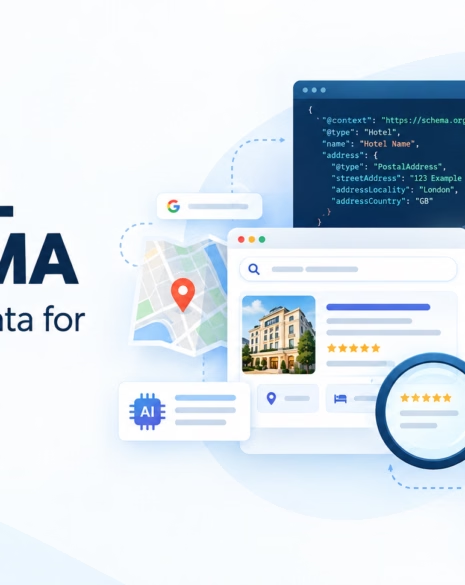
Things like schema markup, structured data, clear page hierarchy, descriptive FAQs, alt text, XML sitemaps and clean technical foundations all help AI systems interpret your content more effectively.
This is not glamorous work, but it is increasingly important.
Hotels that make their websites easier for machines to process will have an advantage over those that only optimise for human design preferences.
A 90-Day Roadmap to Improve AI Visibility
If you are wondering where to start, the good news is that you do not need to do everything at once. But you do need to begin.
Here is a practical 90-day starting point.
First, add FAQs to your most important pages. Every major page on your website should answer real questions in a clear, concise way. These FAQs should be structured properly, with short, direct answers that are easy for AI to extract and use.
Second, begin monitoring your AI shadow. You need to know how AI platforms currently describe your hotel, what strengths they highlight, and what weaknesses they surface.
Third, improve your website’s machine readability. That may include adding an LLMs.txt file, implementing schema markup, cleaning up technical errors, improving metadata and ensuring your content is easy to interpret.
Fourth, fix basic visibility anchors. Missing meta descriptions, weak image alt text, poor technical SEO and inconsistent directory data can all quietly hold you back.
None of this requires a complete overhaul. But together, these steps can make a meaningful difference.
What Happens Next?
The next few years will bring even more change.
We are already seeing the early stages of advertising inside AI platforms. We are seeing travel planning become more AI-led. And we are moving towards a future where autonomous AI agents may increasingly research, shortlist and even transact on behalf of users.
That future may arrive in stages.
First, AI acts as a research assistant. Then it becomes a travel planner. After that, it may become a booking agent. Eventually, we may see forms of AI-to-AI commerce, where a traveller’s AI agent interacts directly with a hotel’s systems to compare options, negotiate criteria and complete actions.
That may sound futuristic, but so did much of what is already happening now.
The Hotels That Adapt Early Will Have the Advantage
The most important point is this: AI search is not a passing trend.
It is changing how travellers discover hotels, how they compare options, and how they decide where to book. That shift has major implications for hotel marketing, brand positioning and digital visibility.
The hotels that adapt early will not just protect their visibility. They will put themselves in a much stronger position to grow it.
Because in this new landscape, it is not enough to have a great website and decent rankings.
You also need to be clearly understood, confidently recommended and positively described by the systems your future guests are increasingly using.
That is the new visibility game.
And it has already started
Want to know how visible your hotel really is in AI search?
Book a free AI Visibility Audit and we’ll show you how your hotel is currently being represented across AI platforms, where the gaps are, and what to prioritise next to improve your visibility. It’s a practical, no-pressure way to understand how AI sees your brand — and what to do about it.